Pages

Monday, November 17, 2014

HUMANS landed a ROBOT on a COMET!!!

Philae, the little lander that could, landed on Comet 67P last week. This mission is such an incredible feat of engineering, science, and math - humans landed a robot on a COMET. Read more about the background of the mission in last week's post

Philae captured this image of the comet as it descended. Image Credit: ESA / Rosetta / Philae / ROLIS / DL

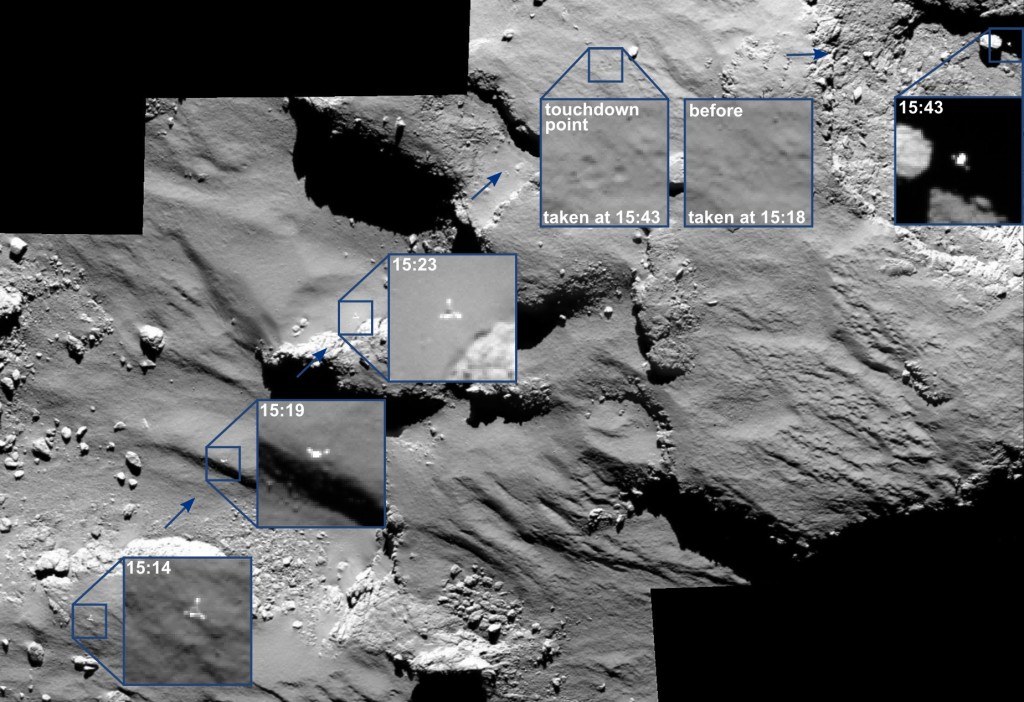
Philae did land on the comet close to where scientists planned, but its landing gear did not deploy. The lander bounced, landed, bounced, and landed again. It ended up on its side in a shadowy spot on the comet - not good for Philae's solar panels. Here is the first picture ever taken from the surface of a comet.


Philae captured the first images from a comet's surface. You can see the lander's foot in the foreground. Image Credit: ESA/Rosetta/Philae/CIVA
Because it did not get enough light to its solar panels, Philae had to rely on battery power, which only lasted until the evening of November 14. The amazing thing is, even with all the challenges and the landing gear failing, Philae was able to complete 80% of its planned science objectives.  Mission leaders hope that when the comet gets closer to the Sun and begins to warm, Philae might wake up again. Read more about the science completed by Philae here


Philae's landing sites were captured in a sequence of images by a camera on Rosetta. Image Credit: ESA/Rosetta/MPS for OSIRIS Team MPS/UPD/LAM/IAA/SSO/INTA/UPM/DASP/IDA

Rosetta is still operating flawlessly, orbiting Comet 67P. It will continue to orbit as the comet swings around the Sun next year. We will get to see images of the comet transform as it heats up and the ice trapped inside starts to vaporize, forming a long tail. 

Image Credit: ESA/J.Mai
Even though Philae's landing didn't go perfectly, just take a moment to think about what the mission team has achieved. They spent about 10 years planning this mission before it launched, and another 10 years flying to the comet. The fact that a group of humans from 20 different countries were able to work together to figure out the details of this very complex and precise mission is very inspiring to me. This comet is only about 2.5 miles across - that is not even a speck compared to the vastness of space. Not only did this team figure out how to orbit the speck, they landed a robot on it! And were able to overcome great challenges to complete most of Philae's mission. For me, this is what space exploration is all about. Uniting great minds to work together, explore new worlds, and learn more about our place in the Universe. Thank you, ESA.

Learn more about Rosetta and other current space news this Friday, November 21, from 7-9 PM at Wine and Cheese Under the Stars! I will be using our dazzling Uniview software to give you a tour of the Universe while you enjoy wine from Willet's Winery. 


No comments:

Post a Comment