Pages

Monday, September 29, 2014

The Middle of Nowhere

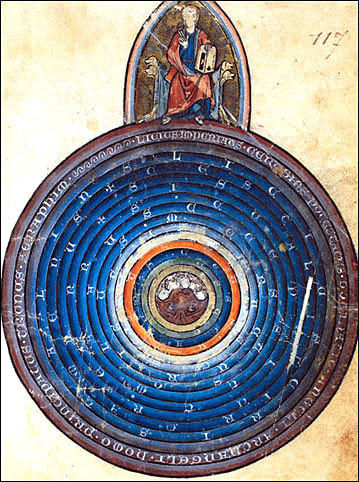
For most of human history, the Earth was considered the center of the Universe. The Sun, Moon, and stars were thought to rotate around us. It made sense to think this way - it looks like they are all moving around us. For this model to be true, the Universe had to be small. The early Greek scholars imagined that the stars were part of a fixed celestial sphere that rotated around the Earth each day. If the star sphere was very far away, the stars would have to be moving incredibly fast to get from sunrise to sunset every day, since they would have to travel a farther distance. 

The stationary Earth at the center of the Universe, with the Moon, Sun, and planets orbiting the Earth in perfect spheres. The stars were in a perfect celestial sphere, relatively close to Earth. Image Credit: luminarium.org
Beginning in the Renaissance, European scientists began studying the motions of the stars and planets again. Copernicus published the first widely read heliocentric model of the solar system in 1543, placing the Sun at the center of the Universe. Copernicus' Universe was a larger one than that of the Greeks - the starry firmament was far away, much more distant than the distance from the Earth to the Sun. 

Copernicus' model was based on observational data. It was not perfect, but so close to being accurate that it could not be ignored. Image credit: Wikipedia commons.

Johannes Kepler refined the Copernican model in 1609 by proving the planets orbited the Sun in elliptical orbits. Kepler, Galileo, and other scientists continued to refine humanity's knowledge of the solar system. But our hubris continued. Most scientists argued that the Sun was the center of the Universe, or close to it. 

Scientists now know that the Sun is not the center of the Universe. In fact, it is not even close to being the center of our galaxy, the Milky Way. The other stars in our galaxy are ridiculously far away from us.

The Sun orbits the center of the Milky Way in an outer region of one of the main arms. Image Credit: Wikipedia Commons.
Edwin Hubble proved in 1924 that our galaxy is not the entire Universe, but just one of billions upon billions of galaxies, all filled with billions or trillions of stars. He also discovered that the Universe is expanding - all galaxies are expanding away from each other, and have been since the big bang. There is no center of the Universe. Our galaxy is one among many. Our solar system is one among many. Our Earth is just a tiny speck in the vast cosmic ocean. Our Earth is in the middle of nowhere. 

Does that make you feel small? On the other hand, does it make you wonder at our ability to know this much about our Universe? 
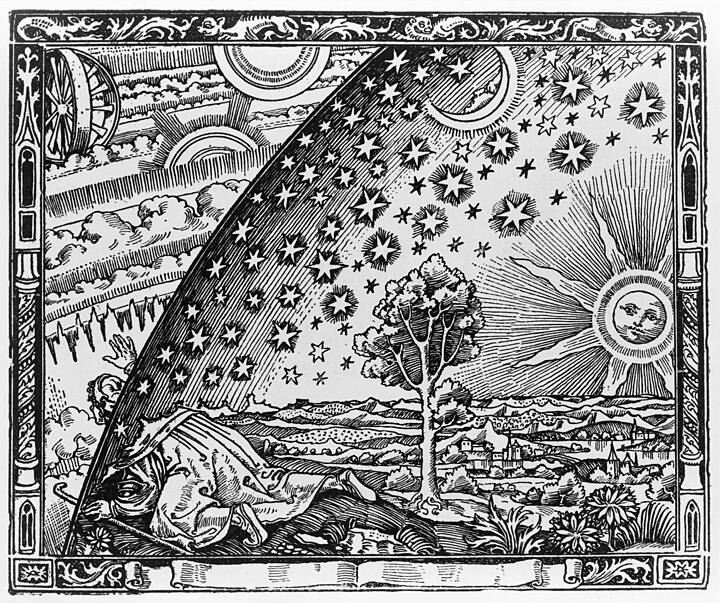
Woodcut by unknown artist, 1888. Image credit: Wikipedia Commons.
To learn more about the shifting human understanding of the Universe, visit the Dome at the Peoria Riverfront Museum and see our brand new show, The Middle of Nowhere. After you have exercised your scientific mind, take in the new art exhibition, Impressionism into Modernism: A Paradigm Shift in American Art.

No comments:

Post a Comment