 |
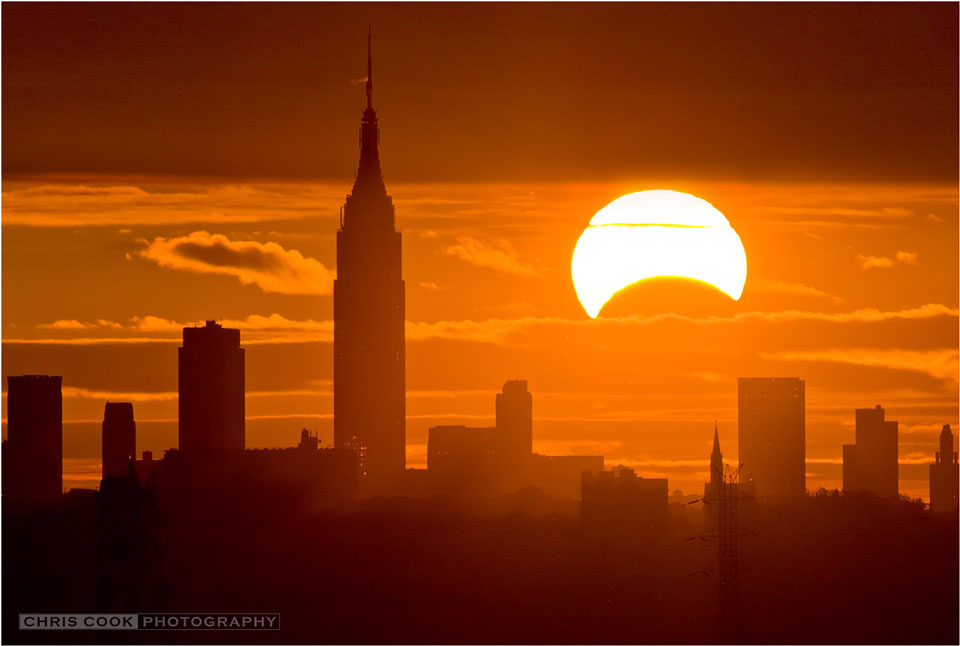
| A partial eclipse over New York City. Image Credit: Chris Cook and APOD |
The partial eclipse will be visible in Peoria just before sunset on October 23. The eclipse will start at 4:38 PM, when the Sun will be fairly low in the west. The Moon will only cover up the top half of the Sun, so if you do not have proper eye protection to look directly at the Sun, you will not be able to tell anything is happening at all. (You can buy eclipse shades in the Peoria Riverfront Museum Store for $1.50). By 5:45 PM, the eclipse will be at its deepest, and the Sun will be quite low on the western horizon, so find a good sunset viewing spot. The Sun sets at 6:05 PM, ending our eclipse viewing in the Peoria area.
 |
| The solar eclipse will be low in the west southwest, so have a good view of the horizon if you want to watch it. Image credit: Stellarium. |
A solar eclipse occurs when the Moon covers up the Sun from our perspective here on Earth. The Sun is 400 times larger than the Moon, but by coincidence is also 400 times farther away, so the two objects appear to be the same size in our sky. This is the reason solar eclipses can occur. Every once in a while, the Moon passes directly between the Sun and the Earth, and blocks out the sunlight for a short amount of time.
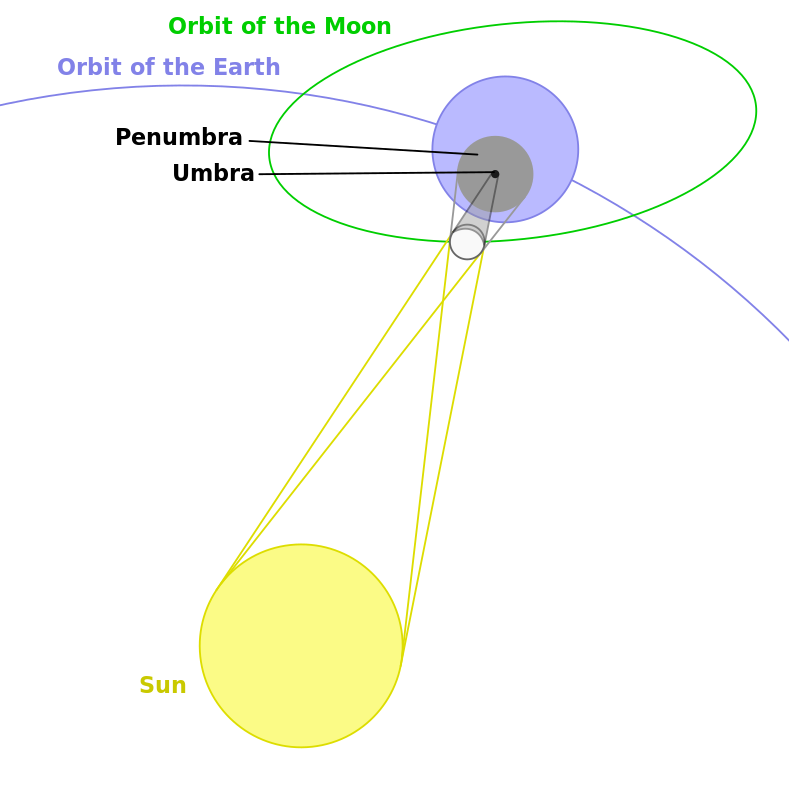 |
| When the Moon passes directly between the Sun and Earth, the people in the dark part of the shadow will see a total solar eclipse. Objects are not to scale. Image Credit: Wikipedia Commons. |
 |
| Image Credit: SMU Physics |
 |
| The shadow of the Moon on the Earth (and path of partial solar eclipse) is the moving oval shadow. Day and night are being shown by the other moving shadow. Image credit: NASA |
If
you want to see a total solar eclipse but don't want to travel very
far, you are in luck! There will be one visible from Southern Illinois
on August 21, 2017. Put the date on your calendar now!
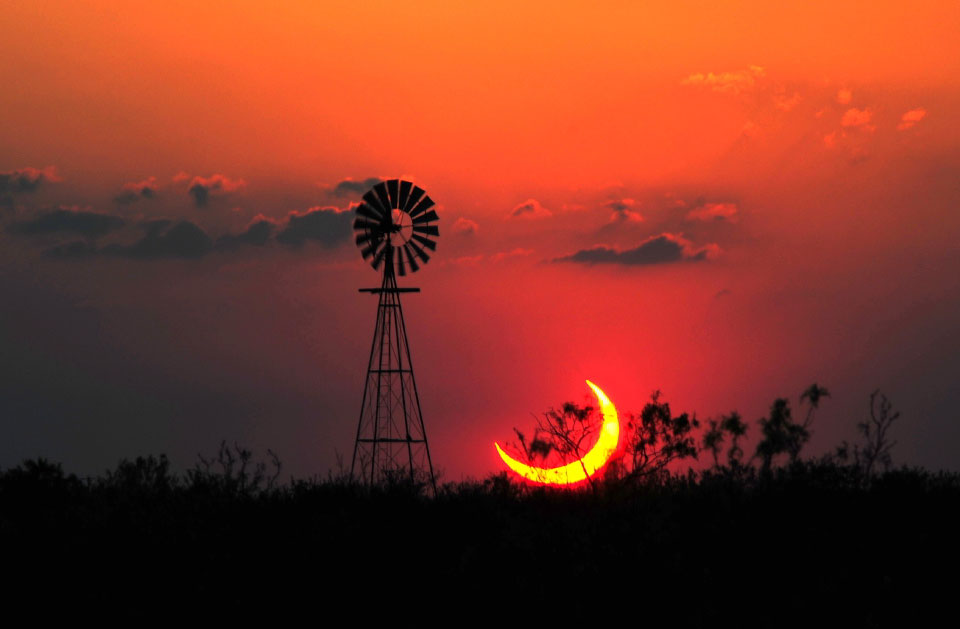 |
| A partial solar eclipse in Texas, 2012. Image credit: Jimmy and Linda Westlake and APOD. |
So pick up a pair of eclipse shades or make your pinhole projector soon! Don't miss the partial solar eclipse on Thursday, October 23, beginning at about 4:30 PM, weather permitting.
You can learn all about space and science at the Peoria Riverfront Museum's Dome Planetarium (all the shows are included with regular admission). And don't miss Wine and Cheese Under the Stars the day after the eclipse, Friday, October 24, from 7-9 PM!

Honeywell Econoswitch 7-Day Solar Time Programmable Switch – $31.49 36% OFF
ReplyDelete