Pages

Monday, June 16, 2014

Godzilla of Earths!

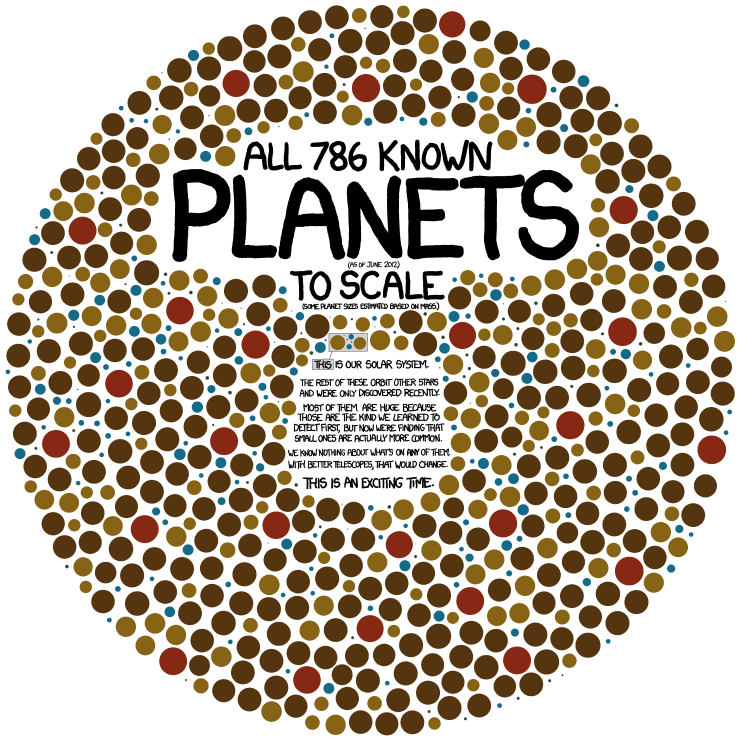
Astronomers have discovered a new rocky exoplanet that is 17 times more massive than Earth! Exoplanets, or planets orbiting stars other than our Sun, are being discovered all the time. It is a very exciting time in astronomy. Did you know that astronomers believe it is likely that MOST of the hundreds of billions of stars in our galaxy have planets orbiting them?! Astronomers have even found planets in the habitable zone, meaning that liquid water might possibly exist on them. Even more exciting, one planet about the same size of Earth was recently discovered in the habitable zone.

Image credit: XKCD, one of the coolest web comics ever. This was made in 2012; the official count of exoplanets now numbers 1732.
On June 2, 2014, astronomers from the Harvard-Smithsonian Center for Astrophysics announced that they discovered a rocky planet named Kepler 10c, 17 times more massive than Earth! This "Godzilla of planets" is unexpected, because it was thought that anything so massive would gather enough hydrogen around it to become a Jupiter-like gas giant. However, this planet is composed entirely of solids, and is much bigger than any other rocky worlds yet discovered. It may also have a thin atmosphere.


This artist's conception shows Kepler 10c, and its companion planet, the lava world Kepler 10b.  Image credit: David A. Aguilar (CfA)
Kepler 10c orbits its Sun-like star once every 45 days, and is about 2.3 times larger in diameter than Earth. It is located about 560 light years away in the constellation of Draco the Dragon, visible in the north. When it was first discovered, scientists expected it to be more like Neptune, because it is so large. However, when they measured the mass of the planet, they discovered it was so heavy that it must be a rocky world. The planet formed about 11 billion years ago, only about 3 billion years after the Big Bang. Scientists are excited about its age, because the young universe was composed almost entirely of hydrogen and helium, and rocky planets would not have been as likely to form. Kepler 10c shows that the universe was able to form huge chunks of rocks even when iron and silicates were relatively rare.

This star system also has another planet, about 3 times more massive than Earth, Kepler 10b, which is described as a "lava world" because it orbits so close to its star - it only takes 20 hours to make the trip around once! 

Image credit:  ASA Ames/Kepler Mission/Jason Rowe/Chris Burke/Wendy Stenzel
The Kepler Space Telescope has been studying one small portion of the sky for about 5 years, looking for exoplanets. It alone has found 4254 planet candidates, and confirmed (meaning observed twice or three times) 974 planets. All of the data gathered by Kepler will take years to study, so many more planets are expected to be discovered. What exciting times! 

So next time you are gazing up at the stars in the evening sky, just imagine all the other worlds that are up there! If you are interested in learning more about exoplanets and other incredible facts about our universe, check out our Astonishing Universe: Believe It or Not! show playing at 3:00 daily at the Dome at the Peoria Riverfront Museum. See a full show schedule and descriptions here.

No comments:

Post a Comment