Pages

Monday, May 19, 2014

Shooting Stars? More Like Falling Rocks.


I love teaching school kids about space and science. We are in field trip season, with hundreds of school children visiting the museum every day in April and May. My favorite part of working with these students in the planetarium is answering their questions about space at the end of the show or lesson. 


Leonid Meteor Shower. Image Credit: Wikipedia Commons
I recently had a student ask me what shooting stars are - a common question. I answered that what we think of as shooting stars are really tiny bits of rock, the size of grains of dust, that enter Earth's atmosphere. As they hit the atmosphere at incredible speeds, the dust grains rapidly compress the air in front of them causing it to rapidly heat up and glow. This is the light that we see. They are not stars at all, but really falling rocks - meteors. This answer always disappoints the little ones. Trying to recapture the students' excitement, I enthusiastically told them that what really is neat about "shooting stars" is that the dust is left behind by comets. When a comet passes through the solar system on its orbit around the sun, tiny bits of rock break off, leaving a dust trail behind. When Earth passes through the dust trail of a comet, we see a meteor shower. Cool, right? The kids didn't seem overly impressed. Maybe I should have played them this song:


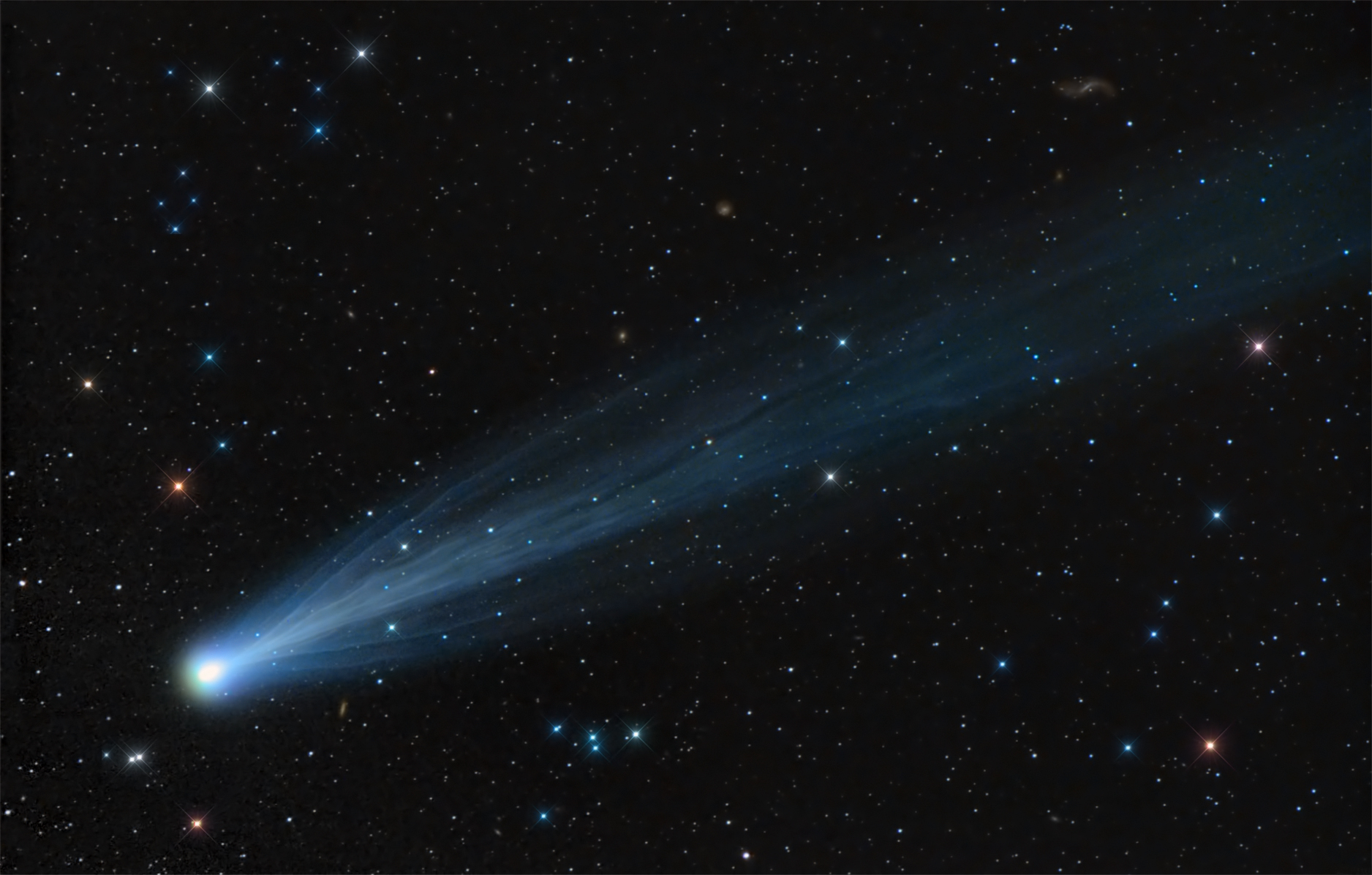
Comet Ison captured by Damian Peach on November 15, 2013.
Because the paths, or dust trails, of comets are known, astronomers can predict very accurately when we will see meteor showers. When observing a meteor shower, it will seem like the meteors originate from one portion of the sky. The meteor showers are usually named after the constellation that it looks like the meteors are coming from. The Perseids (named after the constellation Perseus the Hero) happen every August, and are debris left from the comet Swift-Tuttle, which last passed by Earth in 1992. In late October every year, you can catch the Orionid meteor shower, which is debris left over from Hally's Comet. 

There might be a new meteor shower on May 24, from the trail left behind by Comet 209P/LINEAR. More about this possible shower in our next blog post! 
 
How rogue stars escape the galaxy. Image Credit: NASA

Speaking of shooting stars, there are some stars that are zipping out of the Milky Way Galaxy. Called rogue stars or intergalactic stars, these stars have been detected moving at hypervelocity speeds on a trajectory that will send them outside of the galaxy. Astronomers believe that these stars had a close encounter with the black hole at the center of our galaxy. Probably a companion star was sucked into the black hole, but these wily rogue stars escaped, their orbital paths were changed, and now they are heading out of our galaxy into the void of intergalactic space. Learn more about rogue stars here.

As always, you can learn more about what's up the night sky at the Dome at the Peoria Riverfront Museum. Find our full schedule and show descriptions here. And the next time a kid asks you about shooting stars, you will be ready to explain about falling dust!

No comments:

Post a Comment