Pages

Monday, April 28, 2014

Jupiter - King of the Planets


Have you noticed an exceptionally bright star near the top of the sky, visible as soon as the sun goes down? That super bight object is not a star, it is Jupiter! Jupiter has been brightening up our evenings all winter, and is still visible for a few hours after the sun goes down.

Image Credit: NASA/JPL/USGS [Public domain], via Wikimedia Commons
As soon as the sun goes down, look high in the west. It will be impossible to miss Jupiter, as it is the brightest star-like object in the night sky right now. Jupiter is in the constellation of the Gemini Twins, and will be for about two more months. In late May, Jupiter will start to set at the same time as the Sun, making it impossible to see until about August, when it will rise before the Sun. 


I
Image Credit: Stellarium. Click on the image for a larger view.
Jupiter is a gas giant, the largest planet in our solar system. It is made of mostly hydrogen and helium, which is why it looks so bright in our sky - it is huge, and its clouds reflect a great deal of the Sun's light back to Earth. Jupiter is so big that 11 Earth diameters could fit across the planet. To help visualize the scale of our solar system, check out the Peoria Area Community Solar System. If the Sun were the size of the Peoria Riverfront Museum's Dome Planetarium (46 feet in diameter), Jupiter would be 4.6 feet in diameter, and 4.9 miles away from the museum. In this model, Earth is about 5 inches in diameter, and just about a mile from the museum. 


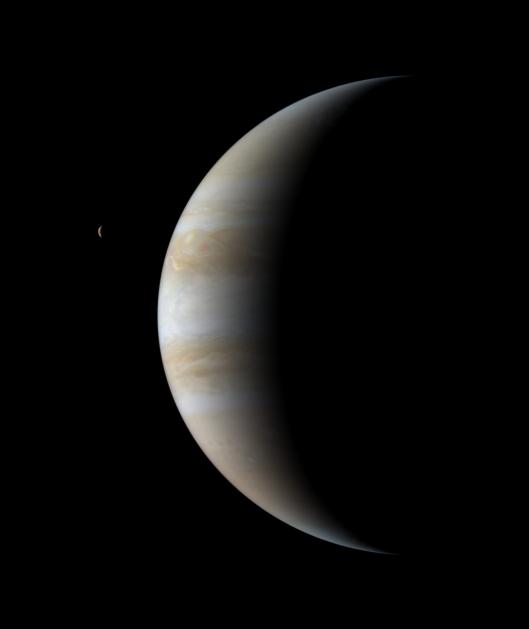
As the Cassini spacecraft sped towards Saturn, it took this picture of Jupiter and its moon Io. Cassini has taken many gorgeous, incredible pictures of Saturn and its moons. Image Credit: NASA/JPL/University of Arizona

Check out a few more beautiful pictures of the King of the Planets. 


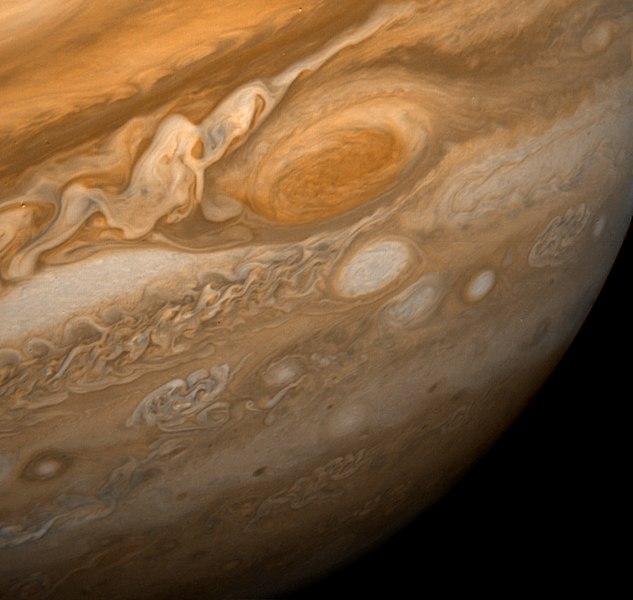
You could fit about 2 Earths across the Great Red Spot, a hurricane that has been raging on Jupiter for over 400 years. Image Credit: NASA
Jupiter and Io. Image Credit: NASA/JPL/USGS [Public domain], via Wikimedia Commons
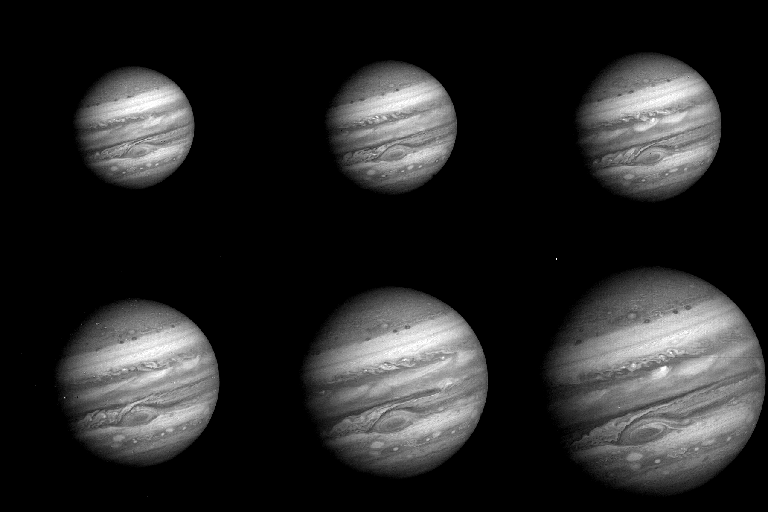
60 Jupiter days are documented in this montage of 66 images from Voyager 1's approach in 1979. Image Credit: JPL/NASA

As always, if you are interested in learning how to find the planets or constellations, visit the Dome at the Peoria Riverfront Museum. Find a full list of show times and descriptions here. For a truly stellar experience, join us for Wine and Cheese Under the Stars this Friday, May 2, from 7-9 PM. Wines from Mackinaw Valley Vineyard will be paired with delicious cheese and SCIENCE! 

Enjoy Jupiter in our night sky!

No comments:

Post a Comment